
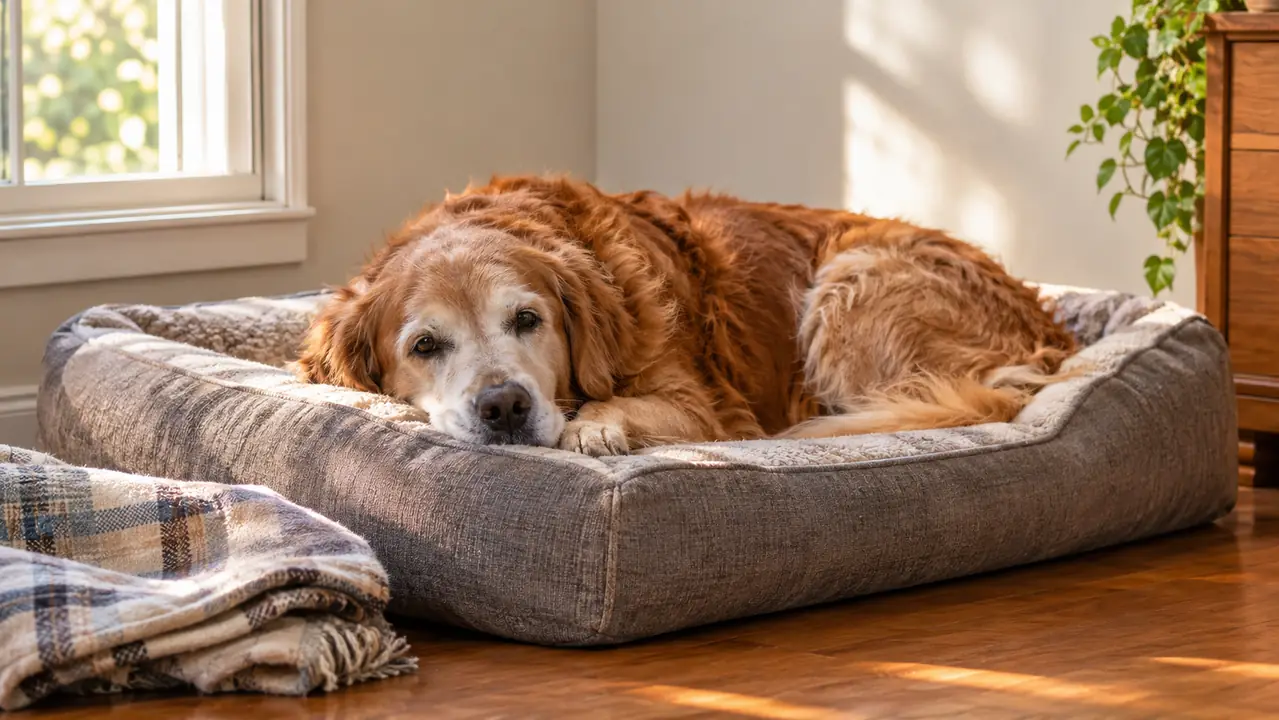
If your old dog circles the bed three or four times before he lies down, or lowers himself in stages like he is testing the floor, the bed itself is part of the conversation and nobody in the pet aisle will bring it up. I have watched this with the big dogs I have had, and I watched it again with Waylon, my yellow Lab, who turned eleven in March. For years he slept on a flat pillow bed in the corner of the living room. That was fine at four. At eleven his hip bones went straight through the padding and found the floor.
Nobody hands you a guide when your dog gets old. You stand in an aisle reading boxes, or you scroll listings at ten at night, and every single one of them says orthopedic. What I did was slow and boring. I measured Waylon flat on his side, I read the weight line on every listing I opened, and I asked Dr. Reyes what to look for before I spent anything. The bed I ended up with is a Bedsure orthopedic bed in Large, 35 by 25 by 7 inches, and he has slept on it since January. It is not a perfect fit for a 68 pound dog and I say so plainly. Here is the order I would do it in if I were starting over.
The bed my old Lab actually sleeps on, with the one number I ignored
It is the Bedsure orthopedic bed in Large, 35 by 25 by 7 inches, rectangular, with bolsters on all four sides and a cover that unzips for the wash. Read the weight recommendation on the listing before you order. Mine says 30 pounds and my dog is 68.
Amazon Check Today's Price on Amazon →Step 1: Measure him lying down, then read the weight line
Do this on the floor with a tape, not from memory. Wait until he is completely flat and measure from the front of his nose to the base of his tail, then across his widest point, which on most old Labs is the hips. Add two or three inches so he can stretch out the way he wants to. A bed that only just fits will have him hanging over the edge by two in the morning, and a dog half off the bed is a dog who stands up stiff and slow and blames you for it.
Then find the weight recommendation and read the number, not the size name. Bedsure lists a maximum weight recommendation of 30 pounds for the size I bought. Waylon is 68. I ordered it anyway because I had the dimensions in front of me and I thought the foam would carry him, and it mostly does. He fits with his head on the bolster and his back legs near the edge. After ten months there is a dent in the foam where his hips rest. If the listing you are looking at offers a size up, take it. I would, and I would not talk myself out of it the way I did.
Large means whatever the seller decides it means. It is not a measurement and it is not a promise. The weight line and the dimensions are the only two things on that page that will not change depending on how the photo was shot, so give them the weight they deserve and be suspicious of anything you cannot put a tape against.
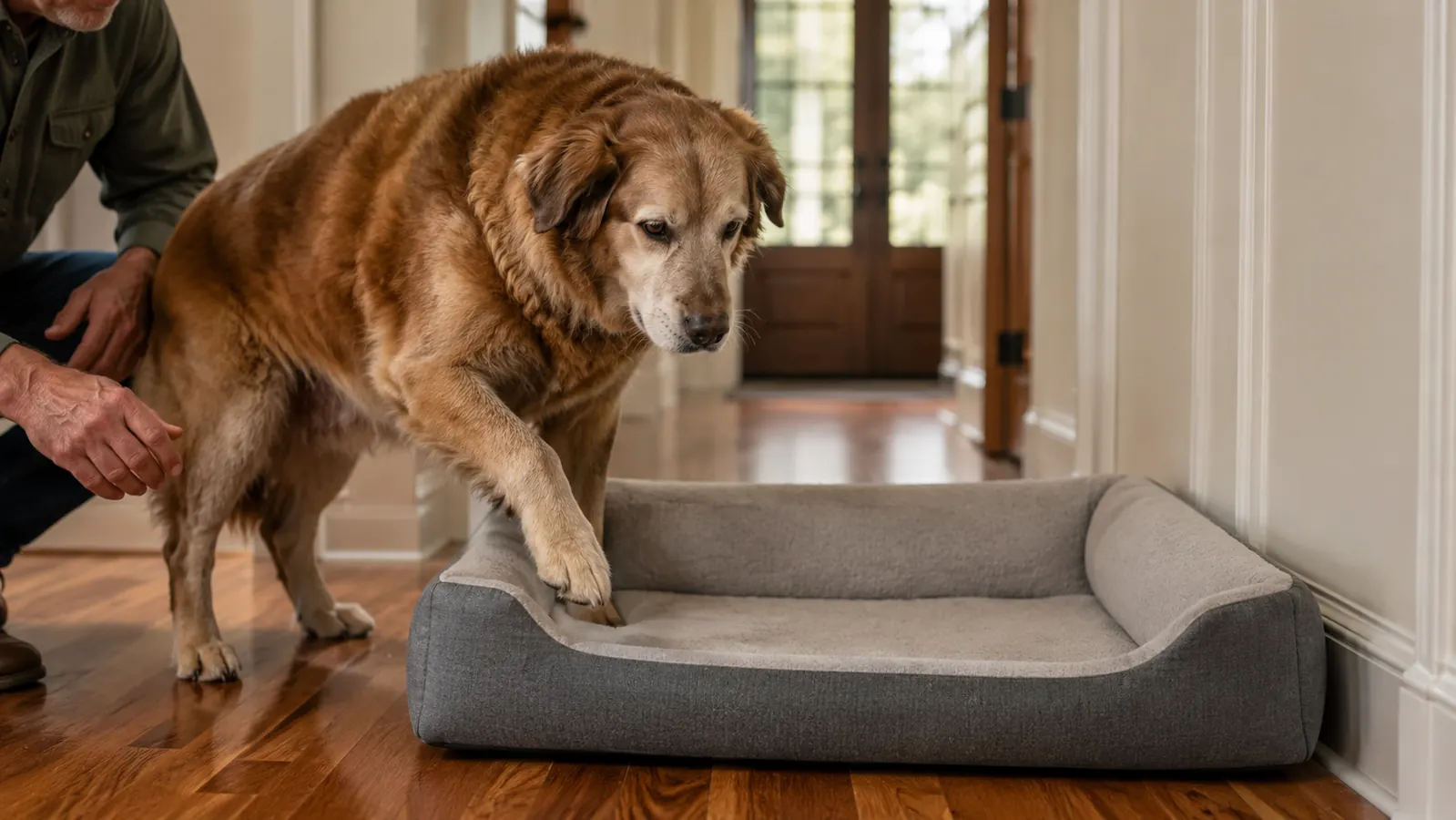
Step 2: Ask what is inside the foam
A bed is foam and fabric, and the foam is the part that decides whether your dog is on a cushion or on the floor by spring. Look for a listing that names the foam and can point to somebody outside the company who checked it. The Bedsure bed uses CertiPUR-US certified foam and materials certified Standard 100 by OEKO-TEX, per the listing, and I looked both of those up before I ordered. I am not a chemist and I cannot tell you how the foam will hold up in year five. I can tell you it held a 68 pound dog for ten months without going flat.
What you are trying to avoid is loose fiber inside a sack. Those beds feel wonderful for a week. Then the fill packs into the corners under the hips and shoulders, and you are back to a dog lying on the floor with extra steps around him. Press your palm into the middle if you can. Good foam pushes back slowly instead of collapsing. If you cannot touch it before you buy, at least make the listing name the material and say who certified it.
Height matters too, and I would take it off the page rather than the picture. The Bedsure is 7 inches tall overall, bolsters included. That is low enough that an old dog can step in without a running start and thick enough that he is not on the boards. If a bed is a foot of wall and your dog is stiff in the back end, he will sleep on the rug beside it and you will have bought a very expensive rug.
Step 3: Match the shape to how he actually sleeps
Watch one full nap before you spend anything. Where does his head go? Does he lean against the couch? Does he drape his chin over the edge of whatever he has now? Waylon sleeps stretched out with his head up on something, so the four bolsters are the reason this bed works for him. He rests his chin on the front one and it takes the weight off his neck.
A dog who curls into a tight ball wants walls around him. A dog who sprawls flat and hates feeling boxed in will push the bolsters down and sleep in the middle, and a tall sided bed will just irritate him. Neither dog is wrong and neither bed is wrong. The bed has to match the sleeper, and that is a thing you can only learn by looking.
This is the one step where you know more than any review, mine included. I can tell you what my dog does in the corner of my living room on a cold morning. I cannot tell you what yours does at your house, and I would not trust anyone who claims they can.
The listing for the size I bought says 30 pounds. Waylon is 68. Read the weight line before you read the photo.

Step 4: Confirm the cover comes off
An old dog will have an accident. It is not a training failure and it is not something to be embarrassed about at the vet's front desk. What matters is whether you can get the cover off, get it into the machine, and have the bed back in service the same day. The Bedsure cover unzips and comes off, and I wash it about every two weeks. The listing also describes the bed as waterproof, which ended up mattering more than I expected, because the foam underneath is the part you cannot rescue once it has soaked.
If a listing does not say the cover is removable, assume it is not. A bed you cannot wash becomes a bed you throw out, and that is the real cost of a cheap one. I would rather wash a cover twelve times a year than replace a bed twice.
While you are reading the page, check the measurements against what shows up at the door. Mine matched. Take thirty seconds with a tape before you cut the packaging open, because a return is a great deal easier when the box is still whole and the bed has not been slept on.
Step 5: Give it three nights, then watch the morning and not the evening
The first night Waylon circled it, put one foot in, took it back out, and slept on the floor beside it. The second night he got in and out twice. He slept on it by the third night, in the corner of the living room, and he has slept on it every night since. Three nights is what my dog needed. It is not a rule and it is not a schedule for yours.
Then watch the morning instead of the evening. Lying down is the easy half. Getting up is the part that tells you something. I noticed he was getting off the bed in the morning with less of a struggle than he had been having with the flat pillow bed, and I cannot prove the foam is the reason. It is one change among several and I am not going to pretend I can separate them.
And if the bed changes nothing after a few weeks, that is an answer too. A bed is not going to be the whole story for an old dog. When Waylon's back legs slid out on the kitchen hardwood one morning in October 2025, a bed was never going to be the fix for that, and I knew it at the time. That is a conversation with your veterinarian, not with me. I am not a vet tech and I am not a trainer. I am a retired school bus dispatcher with an old Lab and a notebook.
What Else Helps
The bed is for sleep and for nothing else. It does not get Waylon across the kitchen floor or up the three wooden steps to the yard. What helped there was a set of grip socks for the hardwood, indoors only and never on walks, and a padded rear sling I keep on a hook by the back door and use on those three steps every morning and evening. What I have noticed is modest: his back legs have not slid out on the kitchen floor the way they did that morning in October 2025, and I cannot prove which thing did what. He also takes a glucosamine chewable with breakfast, and I still cannot swear it is doing anything. If your dog takes medication or has a diagnosed condition, talk to your vet before you add a supplement or change a routine, and never take a serving size off a page like this one. The label and your vet, in that order.
The car is the other half of it. Waylon stopped jumping into the CR-V last October and stood at the back looking at me instead. At 68 pounds I cannot lift him and my husband has a bad back and cannot either, so a folding ramp lives in the cargo area now. It took two weeks of practice, starting flat on the driveway with a piece of cheese, before he would walk it on his own. None of that is a bed. All of it is the same project, which is keeping an old dog off the parts of his day that hurt him.
So no, I am not going to tell you a bed is the answer to an aging dog. It is one of five things in this house and it is probably the cheapest one to get right. The point of the five steps above is to stop you buying twice, which is what I did with a flat pillow bed for six years without noticing that it had stopped doing anything.
Start with the weight line, then decide for yourself
The Bedsure orthopedic bed in Large measures 35 by 25 by 7 inches, rectangular, with bolsters on four sides, a removable washable cover and a listing that calls it waterproof. Check the size chart against your dog's weight before you order, and size up if the listing gives you the option. Mine says 30 pounds, and I would take that seriously.
Amazon Check Today's Price on Amazon →