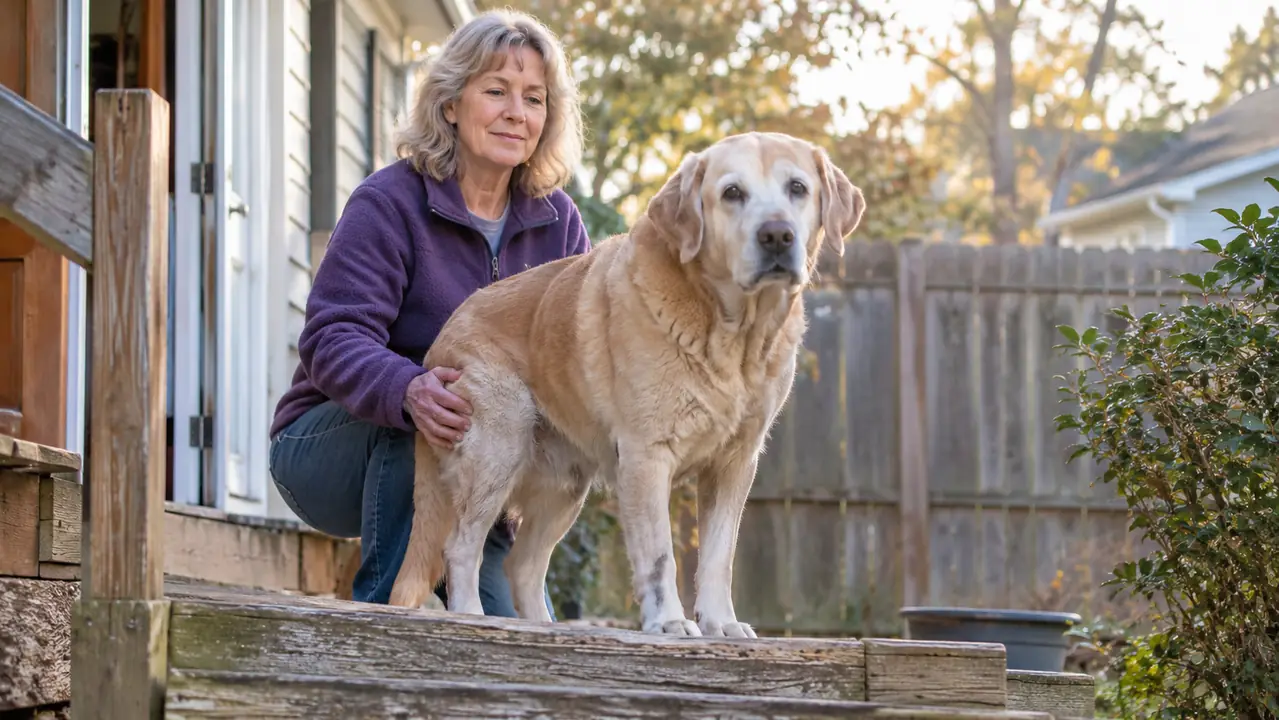
The three wooden steps from my back door down to the fenced yard are not much to look at. Waylon is a yellow Lab, 11 years old, 68 pounds, and last winter he started stopping at the top of them and looking back at me. Not refusing. Just waiting, back legs gathered under him, deciding. I had already watched his back legs slide out from under him on the kitchen hardwood one morning in October 2025, and that same week he stopped at the back of my CR-V and looked at me instead of jumping in. The steps were the next thing to go. I am not a vet and I am not a trainer. I am a 59-year-old retired school bus dispatcher in St. Charles, Missouri, and I am telling you what worked in my house and nothing more.
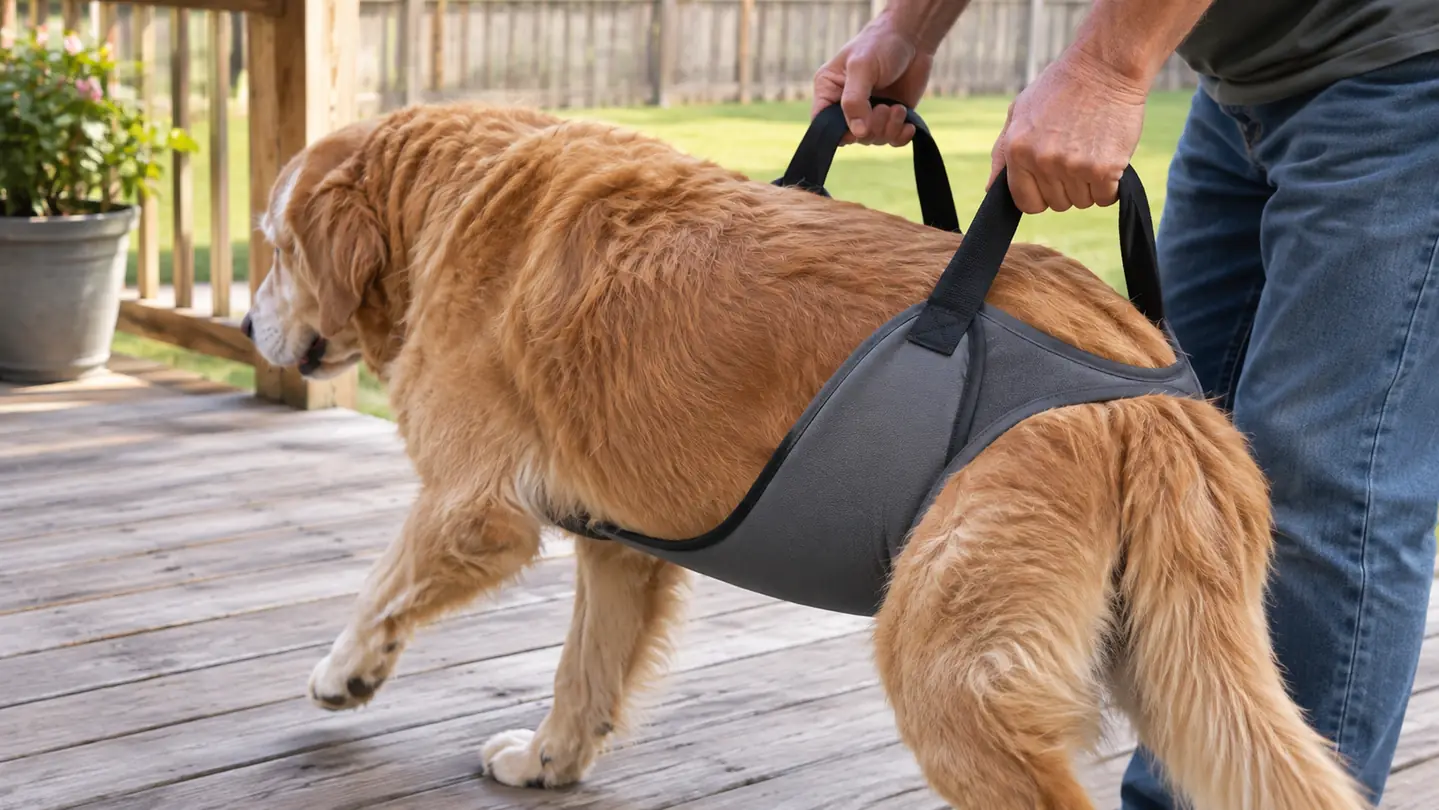
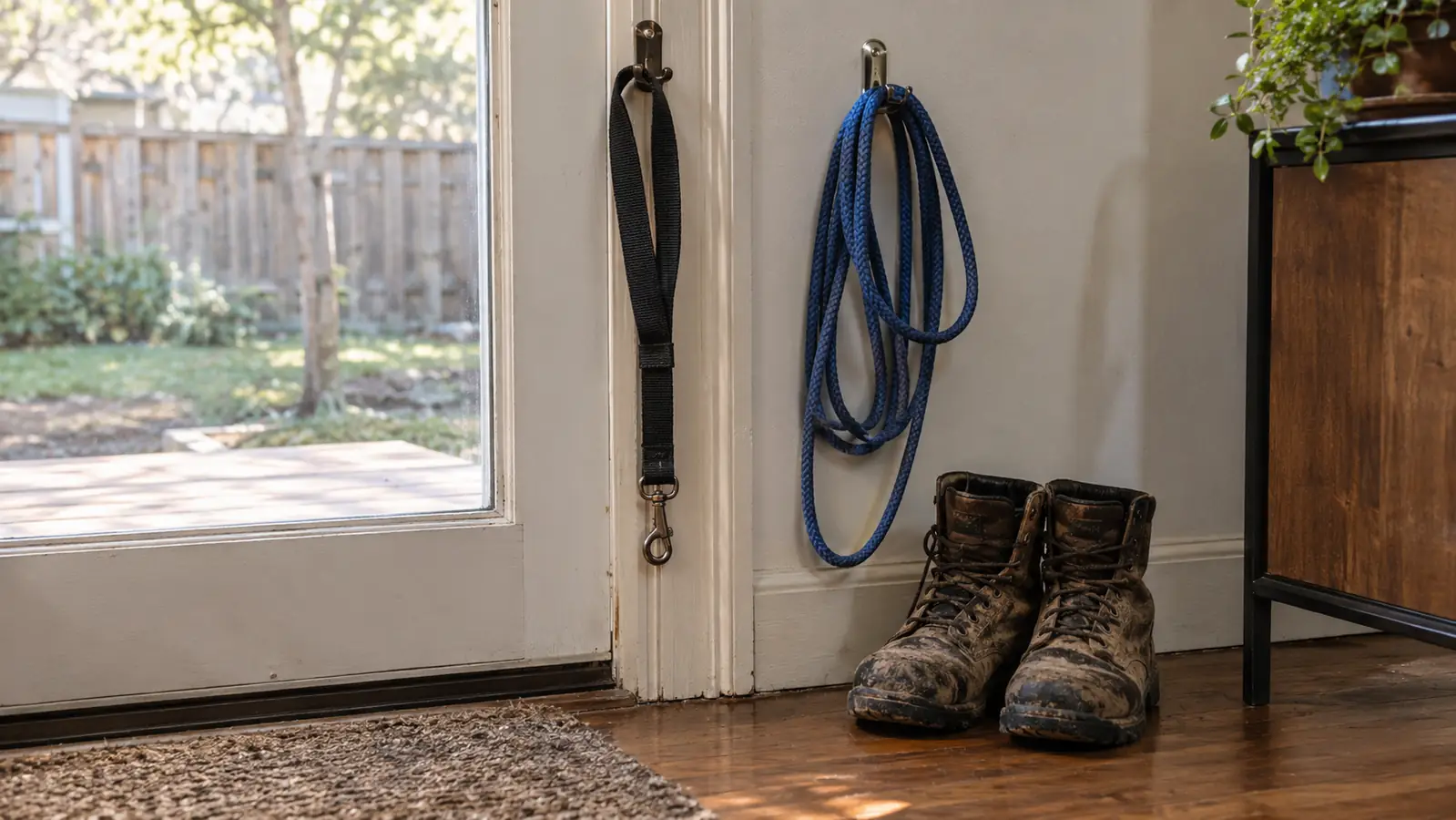
What worked was dull, and it cost less than I expected. It is a padded rear sling called the LOOBANI lift harness, size X-Large: a soft band under the belly and hips with handles on top. I slide it under him every morning and every evening, hold the handles, and let him do the walking. It is not a full body harness and there is no chest piece on it. It hangs on a hook by my back door and has since March 2026. Before I bought it I used an old bath towel for two weeks, and that is worth knowing too, because a towel will tell you whether your dog will tolerate anything under him at all. Here is the order I would do it in if I were starting over.
The band I reach for before the door opens
Rear support with two handles, a soft band that sits under the belly and hips, machine washable, folds into its own bag. It will not lift your dog for you. It lets you take some of the weight off his back end while he uses his own feet. Check the size chart against your dog's weight before you order.
Amazon Check Today's Price on Amazon →Step 1: Get Your Vet's Sign-Off and an Honest Weight
Dr. Reyes has seen Waylon since he was a puppy, and I asked her before I put anything on him or in him, including this. She had me walk him down the hallway and back, put her hands along his back end and his hips, and told me what she thought. I am not going to repeat it in a way that reads like a diagnosis for your dog, because I am not qualified to give one and neither is a webpage. What I will say is that a dog who is slowing down can be slowing down for more than one reason, and a sling only helps with some of them. If your dog has a diagnosed condition or takes medication, that conversation belongs with your vet before it belongs with me.
Ask them to weigh him while you are there. I had been saying 65 pounds for two years. He was 68. That number matters twice: it is how you pick a size, and it is how you decide whether you can physically do this at all. At 68 pounds I can take part of his back end with a band and my own two hands. I cannot carry him. My husband Gary has a bad back and cannot carry him either, which is exactly why a sling made sense in this house and a carrying harness did not. Be honest with yourself about the lifting, because that is the part that decides whether the routine survives past the first week.
While I had her attention I asked whether there was anything else I should be doing, and the answer was the same boring list I have heard for years. Keep him lean. Keep him moving. Keep his nails short. Come back if something changes. She did not offer me a quick fix and I would have been suspicious if she had. The sling is a tool for three wooden steps. That is all it is, and for us that has been enough to be worth the hook by the door. I write this as one owner with one dog, not as anybody's medical advice.
Step 2: Fit the Sling Before You Go Near a Step
The LOOBANI harness in X-Large is nylon, it closes with a drawstring, it is machine washable, and it weighs just under a pound. The listing describes the lining as sheepskin-like, and it is soft enough that Waylon does not fuss at it or try to step out of it. It came with a storage bag that I have never used, because mine lives on a hook by the back door where I can reach it with one hand while holding the door open with the other. Fourteen ounces of nylon is not much to hang on a hook, and it does not take up space in the car when we travel.
There is no chest piece, and I want to be straight about that because it changes what you are buying. This is a rear sling. It does nothing for the front end. If your dog's front legs are the trouble, this is the wrong tool and no amount of careful fitting will fix that, and I would rather tell you now than have you find out in a doorway on a cold morning with a confused dog. Read the listing slowly. A lot of the slings and harnesses sold next to this one wrap the chest or go over the shoulders, and those are different products doing a different job.
Do the first fitting in the kitchen with a leash on. The band sits low, under the belly and in front of the back legs, and the handles come up over his hips. Set the drawstring so the band stays where you put it. If it is loose it slides back toward his tail the moment he moves, and you will spend the whole trip hauling it forward with your knee while he tries to walk. I learned that in the hallway instead of on the steps, which is the right place to learn it. Set it once with him standing still, walk him ten feet, and check where the band ended up.
Step 3: Practice on Flat Ground Until He Stands for It
Flat means flat. Hallway, living room, dry driveway. Band on, leash on, one slow lap. He stood for it the first day, which surprised me. I had it in my head that he would fight it and he did not. He took two or three odd steps, then walked, and I gave him a piece of cheese and took the band off. That was the whole first session, maybe four minutes, and I did not ask for more than that on day one.
Not every dog does that. If your dog lies down, backs away, or goes stiff when the band touches him, take it off and try again tomorrow with the band on for ten seconds and no walking at all. There is no prize for getting up the stairs on the first day. A dog who is worried about the band is a dog who is not thinking about where his feet are, and that is the opposite of what you want at the top of a step. Go at the speed of the dog you actually have.
Two short sessions beat one long one. Five minutes in the morning, five at night, for four or five days. Half of that practice is for the dog and half is for you. By the third day I could get the LOOBANI band under Waylon and the drawstring set in about ten seconds without looking down, and that matters at seven in the morning when the door is open, the coffee is going, and the yard is cold. Fumbling is how people stop using a thing they bought.
Step 4: Take the Steps the Same Way Every Single Time
Up first, not down. Going up is the easier half for both of you and it teaches him what the band feels like when it is doing its job. I stand behind him and slightly to one side so he can see me out of the corner of his eye. Both handles in one hand, held low, near my hip. If my hands are up at my chest I am lifting more than he needs and my shoulders pay for it by Thursday. Low and quiet is the whole technique.
Going down is harder for me and I go slower. One step, stop, let him place his back foot, then the next one. The band is not a brake and it is not a seatbelt. It is a way for me to take some of his weight while he decides where to put his feet. If he rushes, we stop. If I rush, he rushes. Three wooden steps take us maybe twenty seconds and I have stopped apologizing for that. Twenty seconds is cheaper than a fall.
The real trick is timing, and it is not a trick at all. The LOOBANI band goes on before the door opens. If I open the door and then bend down to fit it, he has already committed to the top step and I am catching up. Now he waits at the top while I get the band under him, and that wait is the most useful thing either of us learned in this whole process. A dog who waits is a dog who is not going to try it alone and go down.
Step 5: Keep It the Same, and Know When to Stop
Same three steps, twice a day, in the same order, with the LOOBANI sling in the same place. Waylon knows the routine now and I do too. The steps have not gotten easier and he has not gotten younger. What changed is that I am not standing at the bottom of them with my heart in my throat, waiting to see whether he makes it. That is worth something on its own, and it is most of why I still keep the thing on the hook instead of folded in a closet.
What this does not do, and I will say it plainly because I read a lot of reviews before I bought mine and not enough of them said it: it does nothing for his front end, and it does not mean he can do more stairs than he can do. He still has to do the walking and I still have to bend, every single time, and my back lets me know about it by Friday. He is 11. He is slower than he was last year and he will be slower next year. It helps with one small set of steps and that is the honest size of it.
Stop and call your vet if he cries out, if he stops putting a back paw down where it belongs, if he starts dragging or knuckling that foot, or if the steps get worse instead of holding steady. I am not the person to ask what any of that means. Dr. Reyes is. A sling is help on a bad morning, not an answer to everything that can go wrong with an old dog's back end, and pretending otherwise would be doing you no favors.
What Else Helps
The band did not solve my kitchen floor. Waylon's back legs slid out from under him on the hardwood in October 2025 and that is a separate problem from three wooden steps. He wears grip socks indoors now, on from breakfast to bedtime and off overnight, and I check his paws every night before bed and wash the socks on Sundays. The back two twist by the afternoon and I re-seat them. His back legs have not gone out from under him on that floor since, and I will say that is what I have seen and not a promise about your dog.
The car is a different job again. There is a folding ramp in the back of the CR-V, 62 inches long, and it took two weeks of practice on the driveway with one piece of cheese at a time before he would walk it on his own. He uses it about twice a week, the Saturday walk at Frontier Park and the vet or an errand. On a bad day I steady him with the LOOBANI handles while he walks up the ramp. I never lift him into the car, because at 68 pounds I cannot and neither can Gary, and I would rather take the extra minute.
The rest is small and boring and none of it photographs well. His nails stay short. There is a night light in the hallway now. I sweep the back steps and wipe them when it is wet, and I do not send him out on ice. He sleeps on an orthopedic bed in the corner of the living room and he takes his glucosamine with breakfast, eaten from my hand. Ask your vet before you add anything new to the routine, especially if your dog is on medication for something else. Then pick the one thing that is actually causing you trouble this week and work on that first.
He stood for it the first day. I had braced for a fight and got a dog who waited at the top of the steps while I slid the band under him. That wait is the whole thing.
The sling that hangs by my back door
A rear sling with two handles and a soft band under the belly and hips, machine washable, folds into its own bag when you travel. It takes some weight off his back end on three wooden steps. It does nothing for the front end. That is the honest description and the one I would want if I were you.
Amazon Check Today's Price on Amazon →