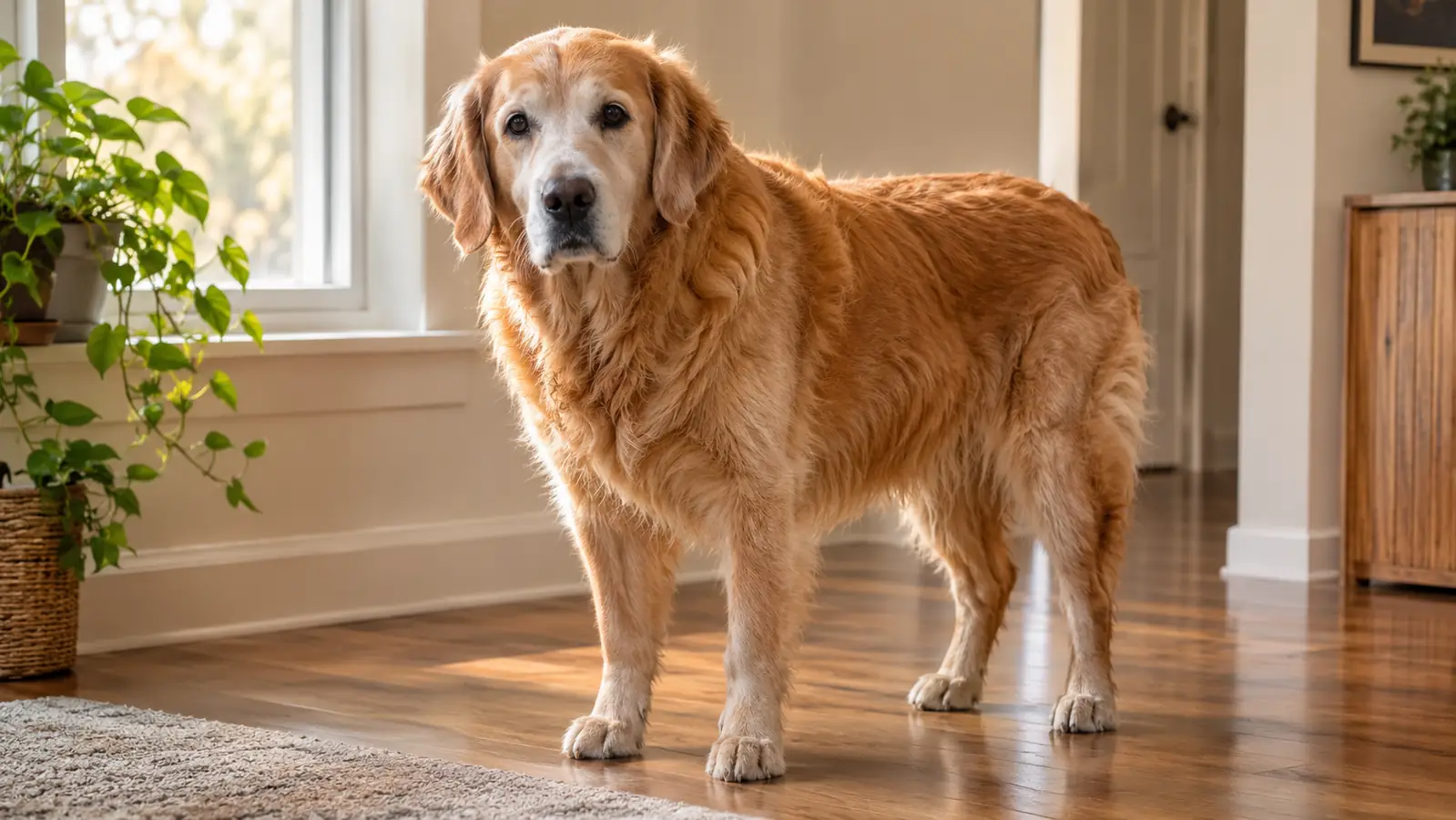
Waylon's back legs slid out from under him on the kitchen hardwood one morning in October 2025. He did not yelp. He went down hard on his back end with his front feet still paddling, like a dog who could not work out what his own body had just done. I had spent a year telling myself he was just getting older, and that was the morning I stopped telling myself that. He was ten then, sixty-eight pounds, and I cannot lift him even if I wanted to.
Two months later, in December 2025, I bought a four-pack of DOK TigerToes non-slip dog socks in size Large. I want to be careful about what I claim for them. They did not make him younger. What they did was simpler and, in this house, bigger: from breakfast to bedtime his feet stay under him instead of sliding out, and he crosses the kitchen again instead of taking the long way around through the living room. Eleven months on, in November 2026, they are on his feet every single day. Here is how we got there, and what I would do differently if I were starting today.
Four socks, one measurement, and a floor he will actually cross
Size Large fits paws 2.5 to 2.8 inches per the listing. Four socks to a set, cotton and nylon, hook and loop closure, machine washable. Measure the paw before you order, not the dog.
Amazon Check Today's Price on Amazon →Step 1: Measure the paw before you order anything
The way this goes wrong most often is size, and it goes wrong because people shop by weight or by breed. The DOK listing gives one number that matters: Large fits paws 2.5 to 2.8 inches. Not pounds, not Labrador. Paw. I measured Waylon while he was standing on a sheet of paper in the kitchen with his weight on the foot, and I marked the widest part of the pad on both sides. He came out just under 2.7 inches on the front and a hair wider on the back. That put him inside the Large range with a little room at both ends, which is where I wanted him.
Do it twice, on two different days. A lifted paw measures differently than a paw taking weight, and a dog who is standing crooked will give you a number you cannot use. If your dog lands near the top of the range, or between the sizes this listing offers, that is a question for the sizing chart on the listing rather than a guess on your part. And if your dog has a diagnosed condition in the paws or the skin between the toes, ask your veterinarian before you wrap anything around them, the same as you would before starting a supplement.
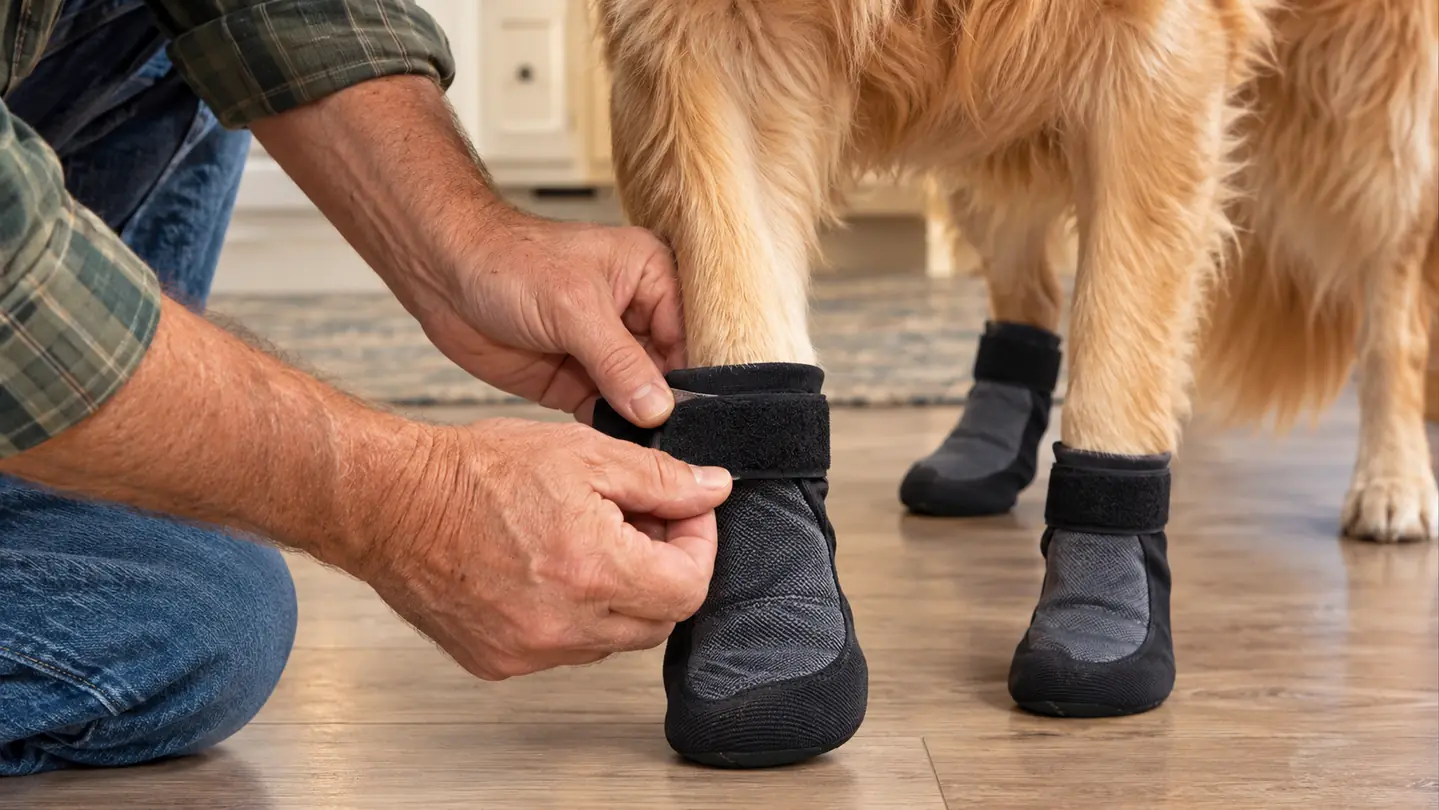
One more thing about fit. The sock has to cover the paw without climbing so high that it bunches behind the toes. If it bunches, the dog feels it with every step and will work at it until it comes off. On Waylon the hook and loop strap of the DOK sock sits snug around the pastern and no higher, and that has held for eleven months.
Step 2: Walk the house and find every place his feet go out
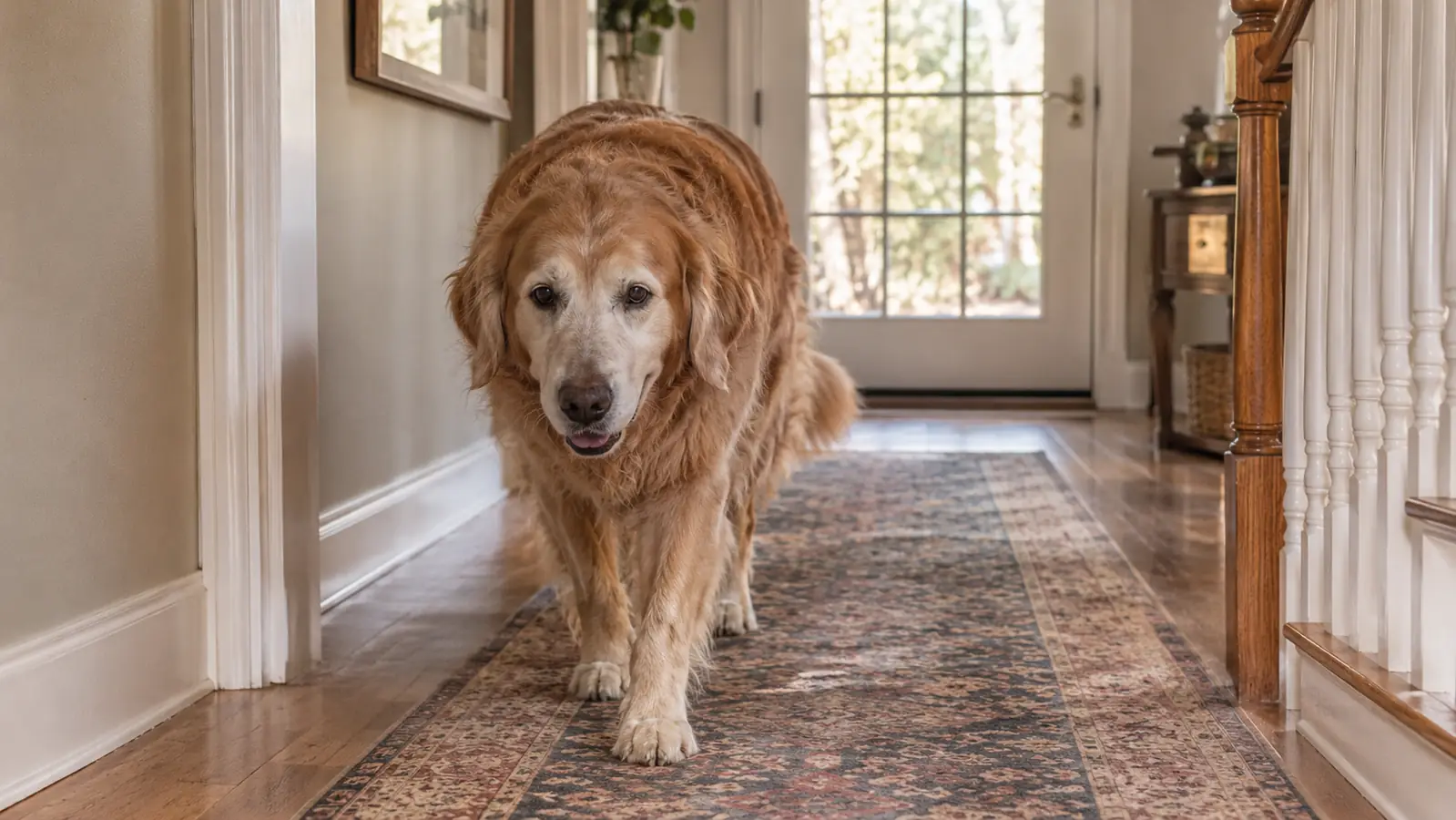
You probably already know the spots. Sit on the floor for ten minutes and watch him instead of guessing. In our house the hallway between the kitchen and the living room is the worst of it, because he turns around there and turning is when the back end goes. The kitchen is second, mostly when he comes in from the back door and tries to slow down on slick wood. The living room is fine except for the two feet of bare floor between the couch and his bed.
Socks are an indoor thing here, and the line is firm. They go on in the house and they come off before we open the back door. They never go on a walk, never out to Frontier Park on Saturday, never into the yard. A wet sock is worse than no sock, and a sock worn on pavement wears through in a week. If you cannot hold that line, do not start, because a dog who wears them outside will start losing them outside.
While you are walking the house, notice the rugs. Where a rug already sits, he is fine. Where the wood is bare for more than two or three steps, that is where I would think about a cheap runner before I thought about anything else. The socks and a rug do different jobs and they stack well. I measured our hallway in paces, went out and bought a runner, and the difference on that one stretch was as big as anything that went on his feet.
Step 3: Put them on wrong once and you will lose him for a month
The first morning I put all four on while he stood in the kitchen, and he high-stepped around that room for about ten minutes like the floor had turned to ice. Each foot came up higher than it needed to go. He kept looking back at me. I stood there and did not make a fuss over it, which was harder than it sounds, and by the third morning he ignored them completely. That is the whole adjustment period in this house: ten minutes of drama, two more days of noticing, then nothing.
What worked for us was putting the DOK socks on while he was already standing on a rug, one paw at a time, and giving him breakfast right after. The last thing that happens in the sequence should be food, not a strange feeling on his feet. I also put them on when I had ten minutes to stand there with him rather than at the exact moment I needed to leave the house, because a dog who panics in socks on a bare floor is a dog who will fight you the next morning.
What did not work: putting them on a dog who was lying down and then asking him to stand up on the wood. He scrambled, I grabbed, and we both had a bad morning. Get him up on a surface with grip first, then dress the feet. The hook and loop closure is easy enough to work one-handed, but no closure on earth is easy on a dog who is already scrabbling.
Step 4: Build the routine around his day, not yours
In this house the socks go on after breakfast, around 6:30, and come off at bedtime, around 9:30. Fifteen hours, every day. He sleeps without them. The first week I was taking them off and on three or four times a day because I was worried about his feet, and all that did was teach him that socks were a thing that happened constantly. Once I settled on once on and once off, at the same times, he stopped paying attention to the whole business.
Every night before the DOK socks come off for good, I check his paws. I look between the toes for damp or redness, I run a thumb over the top of each foot where the strap sits, and I check for a crease that was not there the night before. He has never had a rub spot from these, but I check anyway, because a dog will not tell you and a small thing found on Tuesday is nothing on Friday. Sundays I wash all four in the machine per the care instructions on the listing and let them air dry on a towel on the counter. One set has been enough for us because they are back on his feet by Monday morning.
The back two twist. Mine do, and I have stopped expecting otherwise. By mid afternoon they have rotated and one will slide back toward the ankle. I re-seat them when I notice, usually once a day, and that is the honest downside of this product in this house. The grip is built into the sock rather than stitched onto one patch, and the listing says the traction holds even when the sock has twisted. For Waylon that has been true. A twisted sock still holds on the hardwood, which is the reason I am not more bothered by it than I am.
Step 5: Be honest about what socks cannot do
Socks handle one job here and they handle it well. The DOK socks do nothing for the three wooden steps at the back door. In fact they make those steps worse, because a cotton sock on a wooden tread is slicker than a bare paw. Those steps are the reason I have a padded sling harness hanging on a hook by the door. I take some weight off his back end with it every morning and every evening and let him do the walking. If your house has steps and you put socks on the dog and send him down them, you have solved one problem and created a worse one.
They do nothing for the car either. Waylon loads through the rear hatch of the CR-V on a folding ramp, twice a week, and the socks are off for that. And they do not build strength. They do not fix the reason he is sliding. If your dog is sliding because of a diagnosed condition, that is a conversation with your veterinarian, not a shopping decision, and I would have that conversation before I spent anything. Dr. Reyes has seen Waylon through all of this and I checked with her before every single thing I bought.
Nails matter more than people think, too. A long nail changes how the paw sits on the floor and no sock compensates for it. I keep Waylon's trimmed on the schedule our clinic keeps, and I can tell in the week before a trim that he is clicking on the wood more than usual. That is not a sock problem, and buying a second pair of socks will not solve it.
What Else Helps
Three things around this house do as much work as the socks. The first is a runner rug down the hallway. It cost less than the DOK socks and it removed the worst stretch of bare wood in the house. The second is the sling harness on the back steps, used twice a day, every day, which lets him keep doing the climbing himself instead of me lifting him. The third is the ramp at the CR-V, which is the only reason he still goes to Frontier Park on Saturday mornings at all. None of these is exciting and none of them is a cure for anything. They are just the handful of things that let an old dog keep doing the ordinary parts of his day.
I will say the plain version, because I wish somebody had said it to me in October 2025. Nothing fixed him. He is eleven, he is slower than he was at nine, and cold mornings are still his stiffest. What changed is that he stopped being afraid of his own floor. The socks are one piece of that, and they are the piece I would buy first if I had to start over, because the floor is where he spends his day and where he went down in the first place.
The socks did not make him young again. They took the fear out of the kitchen floor, and that is the reason he still walks across it.
Measure the paw, order the four-pack, and give the kitchen floor back to him
Size Large fits paws 2.5 to 2.8 inches per the listing. Four DOK socks per set, cotton and nylon, hook and loop closure, machine washable. Ask your veterinarian first if your dog has a diagnosed condition or is on medication.
Amazon Check Today's Price on Amazon →