
Waylon slid on the kitchen hardwood on a Tuesday morning in October 2025. His back legs went out from under him, he scrabbled at the floor with his front paws, and then he stood up and looked at me like nothing had happened. He was ten that fall. The same week he stopped at the back of the CR-V, looked at the bumper, and waited for me to do something about it. I could not lift him. He is sixty-eight pounds now, my husband Gary has a bad back, and I have never once picked that dog up. That was the week I started reading joint supplement labels in the feed store aisle with my reading glasses on, and the first thing I bought was Nutramax Laboratories Cosequin chewable tablets.
Let me be clear about who is writing this. I am not a veterinarian or a vet tech or a trainer. I am a retired school bus dispatcher in St. Charles, Missouri, and I have had big dogs for most of my life, which means I have watched a few of them slow down. Before I bought that tub I stood in the aisle and counted eleven different joint products on one shelf. Powders, chews, tablets, liquids, soft chews with a puppy on the bag. Not one of them told me what I needed to know. What made the difference was calling Dr. Reyes at our clinic and asking her flat out whether a joint supplement was a reasonable place to start. She talked me through it, and that call is the reason I felt all right about buying anything at all.
Start With the One Whose Label I Could Actually Read
Nutramax Laboratories Cosequin is a chewable tablet with the active ingredients printed where you can see them before you spend a dime. Ask your vet first, then take the amount off the label for your dog's weight instead of guessing.
Amazon Check Today's Price on Amazon →Step 1: Talk With Your Vet Before You Buy Anything
I called the clinic and asked the receptionist for a call back, and Dr. Reyes rang me that afternoon. I told her what I had seen. The slide on the hardwood, the stop at the back of the CR-V, that he was stiffest on cold mornings, that the walk around the block had gone from twenty minutes to about fifteen. I did not diagnose him off the internet and neither should you. She asked me when he was worst and whether he was still eating, and then she had me bring him in rather than guess at it over the phone. That visit is the reason I felt steady about the whole thing.
Have the facts ready when you call, because it makes the conversation shorter and better. Your dog's weight on a real scale, not your best guess from holding him on the bathroom scale with you. What you have noticed and roughly when you first noticed it. Every medication and every supplement your dog is already getting, including the things you would not call medicine. Dr. Reyes asked me all of it and I was glad I had written it down the week before. I am not qualified to tell you what interacts with what. I can tell you the question is worth asking before you add a single thing to the bowl.
One more note about that call. I asked her whether it was reasonable to try a joint supplement at all, and I asked what she would do if he were hers. She gave me an answer I could act on, and I acted on it. If your vet says to start somewhere else, start somewhere else. There is no shame in a tub sitting on the shelf for six months while you do the other thing first, and nobody is keeping score at the end of it.
Step 2: Read the Label and Match It to Your Dog's Weight
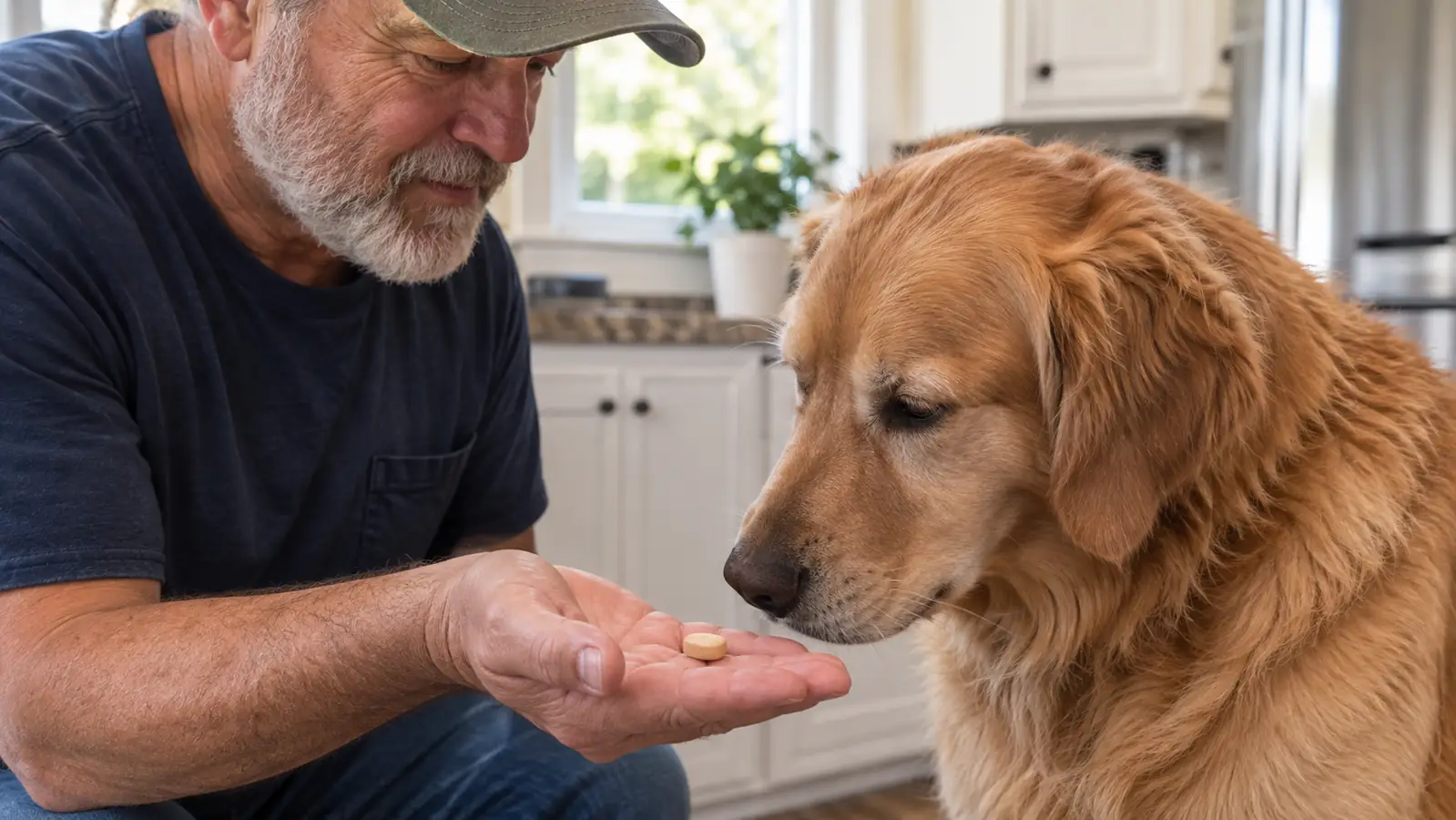
The label on the Nutramax Laboratories Cosequin tub lists three active ingredients: glucosamine hydrochloride, sodium chondroitin sulfate, and MSM. That is the whole of what is doing the work, printed where you can read it before you spend anything. If somebody told you glucosamine alone is the whole story, this product is not that, and the label says as much.
What the label does not do is tell you how much your particular dog gets. That comes off the label by weight, and the label is the only place you should be taking a number from. Not from me, not from a comment thread, not from a video made by somebody with a dog half Waylon's size. My dog is sixty-eight pounds, so I read the amount for his weight and give him that once a day. Your dog will land on a different amount. Ask Dr. Reyes to confirm it before you start, and check it again if your dog gains or loses a few pounds, because the amount changes even when the dog does not feel different to you.
Buy a size that suits your dog. The 132 count is what I buy, and at a big dog's serving it does not last as long as it sounds like it will. That is not a complaint about the product, it is arithmetic, and doing that arithmetic before you order saves you from running out midweek. There is nothing worse than scraping the bottom on a Sunday and deciding to skip a few days because the store is closed and you are already in your slippers.
Step 3: Pick One Time of Day and One Way of Giving It
Waylon gets his at breakfast, out of my hand, before the kibble goes down. One time a day, the same time every day, in the same spot on the kitchen floor. That is not a dosing instruction, it is a memory aid, and it is the single most useful thing I can pass along. When you are giving something once a day for weeks on end, the only version that survives is the one bolted to something you already do without thinking about it. Breakfast happens whether or not I remember anything, and I have forgotten plenty of things.
The tablets are plain and they crumble. Waylon takes his dry from my hand and always has, which I know is luck and not skill. If your dog is pickier you will find out in a hurry, and a little cheese or a spoon of wet food is how most people I know solve it. Do not turn it into a production. A dog who learns the tablet comes with a ritual starts expecting the ritual, and then you are standing in the kitchen at seven in the morning performing it while the coffee goes cold.
Watch the first few days and take note of what you actually see. Not because anything dramatic happens, but because you will want a baseline to compare against later. I wrote down how long he took to get up off the floor and whether he cleaned his bowl. That is the level of detail that turns out to be worth having. A week from now you will not remember whether Tuesday was better than Monday, and neither will I.

Step 4: Change Nothing Else for the First Few Weeks
This is the step I would underline twice if I were handing this to a friend. Change one thing at a time. I bought the Cosequin in October. The next thing I bought for him was a set of socks in December. The bed came in January, the harness in March, the ramp in May. Months apart, one at a time, and only after asking Dr. Reyes each time.
It is tempting to fix everything in one weekend. I understand the impulse completely, because the dog is getting older and it feels like there is no time to waste. But if you add a supplement, a new bed, and a harness in the same seven days, you have learned nothing at all. If something does not sit right with him, you will not know which of the three it was, and you will be pulling all of it back out of his routine to find out. I would rather know.
Keep the rest of the day exactly as it was. Same food, same walks, same times, same floor. If the food has to change, change it in a different month and write that down too. I am not a vet and I am not going to tell you what causes what in a dog's stomach or anywhere else. I can tell you that one dog in one house is easier to read when only one thing about his week is different from the week before.
Step 5: Write It Down, and Give It Weeks Instead of Days
I kept a small notebook on the counter by the coffee maker. Date, what I gave him, and one line about how he moved that day. Getting up off the floor. The three wooden steps down to the yard. Whether he walked to the back of the CR-V on his own or stopped and waited. It took ten seconds a day and I am still doing it thirteen months later, mostly out of habit now.
About six weeks in, I noticed he seemed to get up off the floor a little easier. That is the whole of the claim I am making, and I want to be honest about the size of it. I cannot swear it was the tablets. By then he was also sleeping on a better bed, and he had socks on the hardwood, and I am one woman watching one dog in one kitchen. If you came here for a promise that your dog will be different in six weeks, I do not have one and I do not trust anyone who says they do.
Give it weeks, not days. Nothing about an older dog changes overnight, and the calendar is the thing that will talk you out of staying with it. My own rule was that I would not judge anything before a month was up, and I would not change anything before then either. That rule is the reason I know what I know. It is also the reason I can tell you plainly that nothing fixed him. Waylon is still an old dog. He is slower than he was two years ago and he will be slower again next year. What I have is a routine that fits him, not a cure for aging, and anyone selling you the second thing is selling you something.
About six weeks in, he got up off the floor a little easier. I cannot swear it was the tablets, and I have stopped pretending otherwise.
What Else Helps
The supplement is one piece of a week, not the whole of it. The socks go on after breakfast and come off at bedtime, indoors only, never on a walk. They are for the hardwood in the hallway, the kitchen and the living room, because that floor is what took his legs out in the first place. I check his paws every night and wash the socks on Sundays. The back two twist by the afternoon and I have to re-seat them, which is irritating and also not a reason to stop.
The harness hangs on a hook by the back door. It is a padded sling that goes under his belly and hips, and I use it on the three wooden steps every morning and every evening, taking some of his weight so he can do the walking himself rather than being carried. The ramp lives folded in the back of the CR-V. It comes out about twice a week, for the Saturday walk at Frontier Park and for errands, and I do not lift him into that car. At sixty-eight pounds, with a husband who has a bad back, the ramp is the only reason he still goes anywhere at all.
The bed sits in the corner of the living room and he is on it by nine-thirty every night. It replaced a flat pillow bed that had gone to nothing. I cannot prove which of these things helped and neither can you, and any article that claims to have sorted it out for your dog is guessing at your dog. If your dog is older and stiff, the floor he walks on, the steps he takes, the surface he sleeps on and what goes in his bowl are all one picture. The supplement is the piece that goes in his mouth. It is not the only piece, and it was not the first thing that changed his day.
One last thing, and it is the least popular thing to say. Start with the phone call, not the shopping cart. I have a neighbor who ordered three joint products in one week and could not tell me which one she was still giving six months later. I have another who asked her vet first and never needed more than one. The difference between those two houses was not the product. It was the order they did things in, and the order is free.
Start With One Thing and a Phone Call to Your Vet
Ask your vet, read the label for your dog's weight, and give it a month before you decide anything. Nutramax Laboratories Cosequin chewable tablets are where I started in October 2025, and they are still what goes in his breakfast.
Amazon Check Today's Price on Amazon →