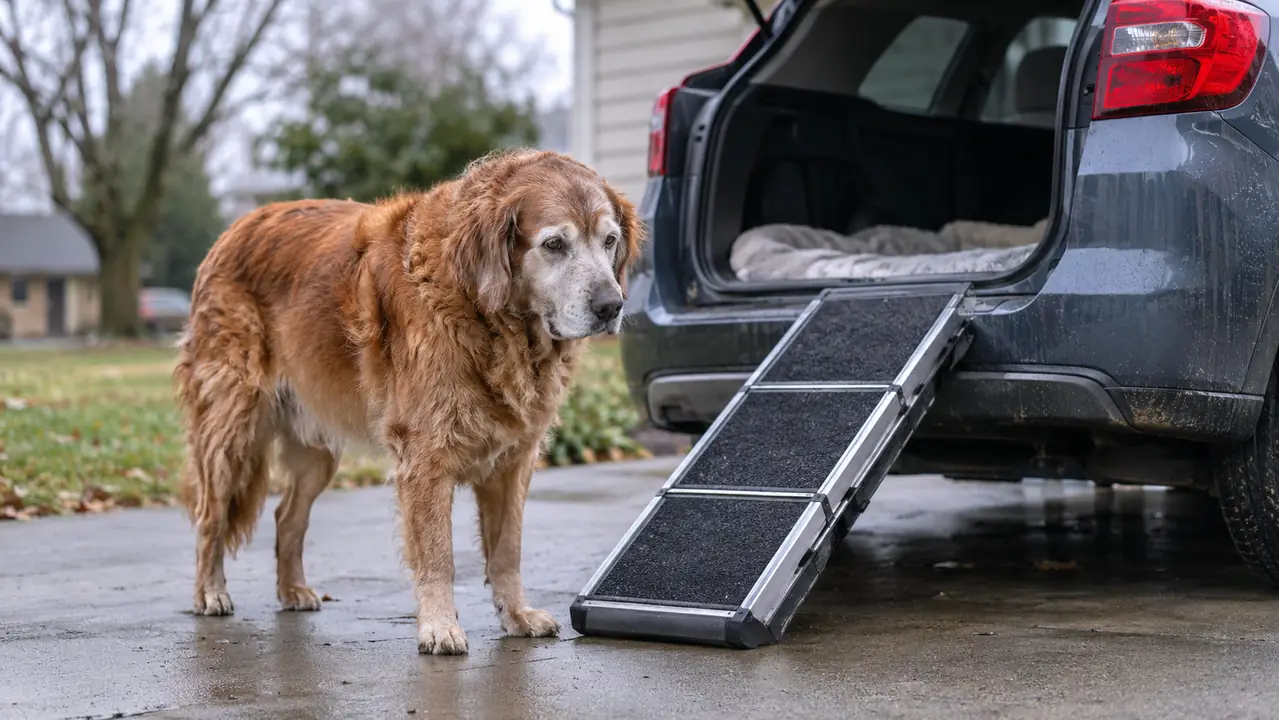
The first time Waylon stopped at the back of my CR-V and simply looked at me, I did not own a ramp. I had a 68 pound yellow Labrador who had climbed into that hatch a few thousand times without a second thought, and one morning in October 2025 he stood behind the bumper with his back legs gathered up under him and waited for me to fix it. I am 59. My husband Gary has a bad back and does not lift the dog. So the two of us stood in the driveway doing arithmetic on a problem I had been ignoring for a while.
I called Dr. Reyes, our vet, before I bought anything and asked what she would try. That is how the towel came first, then the harness, then the ramp. The PetSafe Happy Ride folding ramp came home in May 2026 and has ridden folded in the back of the CR-V ever since. Six months of Saturday trips to Frontier Park, vet visits and ordinary errands later, I have a fair picture of what it does and what it does not.
The Quick Verdict
A light, steady ramp that got my old Lab into the hatch without either of us lifting him. The two week learning curve is real, and 10 pounds gets clumsy to swing out in a crowded parking lot.
Amazon Check Today's Price →The ramp that ended the standoff at the back of the car
62 inches long, 16 inches wide, 10 pounds, rated to 150 pounds. It has lived folded in my cargo area since May.
Amazon Check Today's Price on Amazon →How I've Used It
The ramp is for the CR-V and nothing else. Waylon uses it about twice a week, which does not sound like much until you remember what those two trips are: the Saturday morning drive to Frontier Park for a slow walk by the river, and the vet or a run to the hardware store. Those are the two things an old dog still very much wants to do, and they had quietly become the two hardest parts of his week.
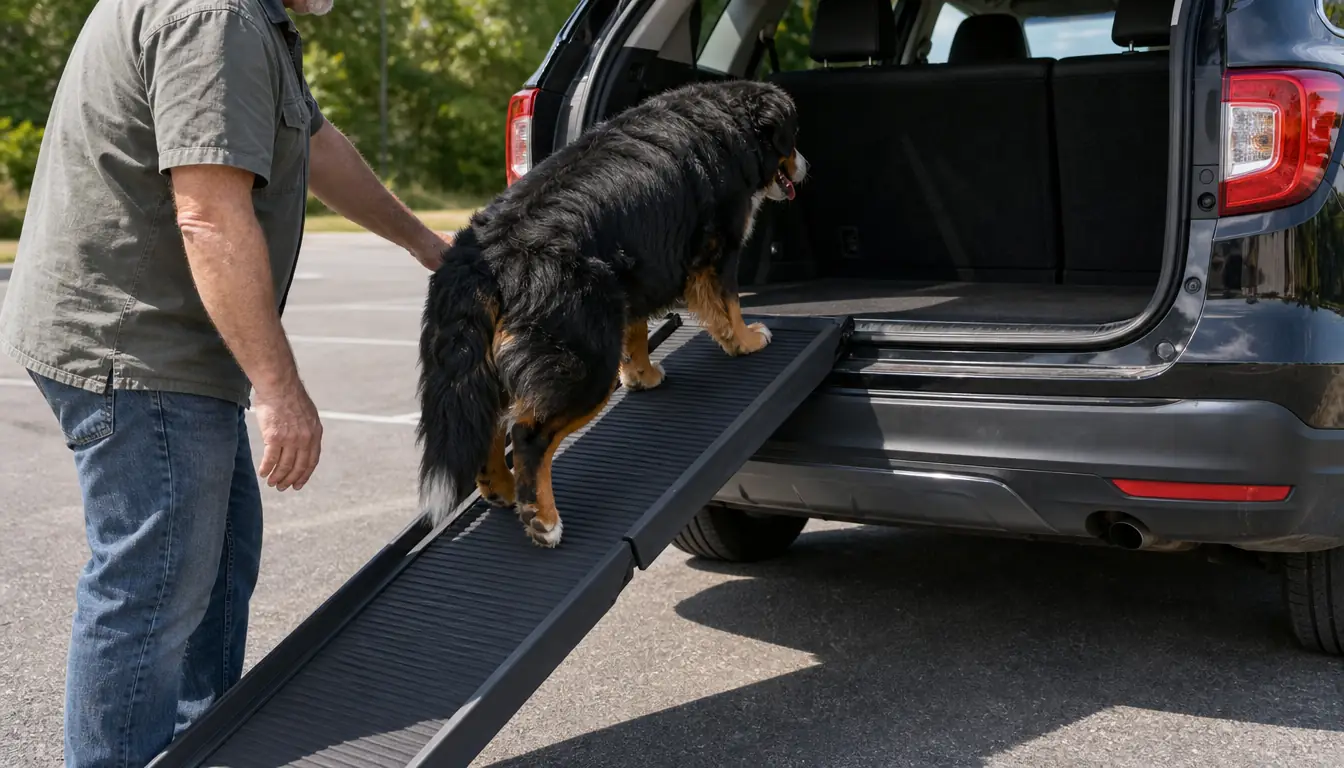
The car is a 2017 Honda CR-V, loaded through the rear hatch. I park, open the hatch, pull the ramp out of the cargo area, unfold it and set the top edge on the sill. Waylon walks up. I fold it and put it back. From the moment I put the car in park to the moment the hatch closes again is maybe three minutes, and most of that is me being careful about where I put my feet.
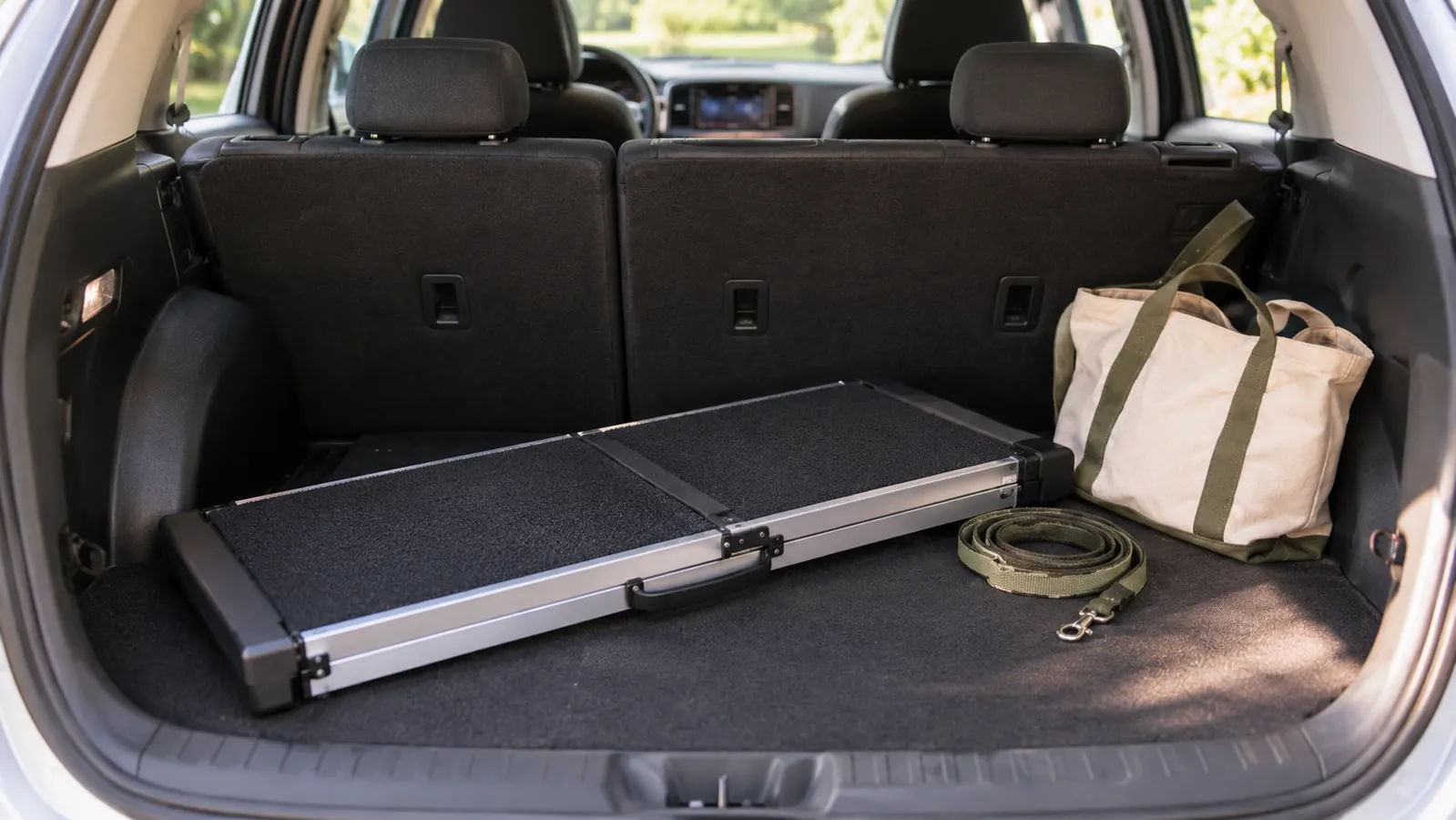
The routine has a rhythm to it now. I keep a canvas tote in the cargo area beside the folded ramp with the leash, a roll of paper towels and the cheese, which sounds fussy until the morning you drive all the way to the park without the cheese. On a Saturday I pull in around eight, before the lot fills, and I take a space at the far end where nobody parks tight behind me. Ramp down on the asphalt, Waylon up, ramp folded, hatch closed. The whole production is over before the coffee in the cup holder goes cold.
At home it stays folded behind the back seat. He does not use it indoors. The three wooden steps down to the yard are handled with the rear harness, and the hardwood in the hallway and kitchen gets the socks. If you are picturing one piece of equipment that solves every surface in a dog's life, that is not how it went for us. It is one tool for one job, and the job is the height of a hatch.
The other place it earns its space is the vet's parking lot. That lot is cramped, the spaces are narrow, and there was a period when I would circle twice looking for one with room to open the hatch all the way. The ramp needs the full hatch height and a clear patch of ground behind the bumper. Now I just take the first space and set it down, and Waylon is up and in before anyone honks at me.
What the Ramp Is, in Plain Terms
The PetSafe listing is unusually clear about the numbers, so I will just repeat them. Sixty two inches long, sixteen inches wide, four inches high when folded, ten pounds. Plastic. It folds in half at a hinge, and there is a safety release latch so it does not open up on you while you are carrying it. The walking surface has a high traction tread, there are side rails down both edges, and four rubber feet sit at the base. Load capacity is 150 pounds. The listing also says it is made in the United States.
Waylon is 68 pounds, so there is a lot of room under that 150 pound figure. The sixteen inches of width is the number I would look at hardest if your dog is broader than mine or tends to swing his back end around. Waylon walks a fairly straight line up the middle. The side rails give him something to feel on either side of him, and I think that matters more than it sounds like it would. A dog who crabs sideways is going to use every inch of that sixteen.
It is two panels and a hinge. No telescoping sections, no adjustment, nothing to set or lock into a position. You unfold it and you set it down. I have come to like that more than I expected to, because the fewer things there are to go wrong at the side of a car in the rain, the better I like a piece of equipment.
Two Weeks of Practice, One Piece of Cheese at a Time
He did not walk up the ramp the day I brought it home. I want to be plain about that, because it is the part that surprised me and the part no listing photograph prepares you for. The first afternoon I laid it flat on the driveway, which was a walk across the garage floor rather than any kind of incline. He sniffed it, took the cheese and refused to put a paw on it.
So we did that for a few days. Flat on the driveway, cheese at the far end, me standing off to the side trying to look like a person with no opinions about any of it. Then I raised one end onto the hatch sill, low, and we did it again. Then all the way up. It took about two weeks of short sessions, and by the end of the second week he was walking it on his own without being coaxed or steadied.
There was one Thursday in that second week I remember clearly, because it was the day it stopped being a lesson. I had set the ramp on the sill and turned around to pick up the leash off the ground, and when I turned back he was already standing in the cargo area looking out at me over the seat. I had not asked him. I had not even reached for the cheese yet. That is the point where the practicing ends and the ramp just becomes part of getting into the car.
Two weeks is the number I would tell any friend to budget for. Not because the ramp is difficult to use but because a dog who has stopped trusting his back legs is in no hurry to trust a new surface. I kept the sessions short and I quit while he was still willing. If your dog is food motivated, cheese does most of the teaching. If he is not, expect this to take longer, and understand that the delay is not a defect in the ramp.
What I Liked
- 10 pounds, and it folds in half, so it fits behind the back seat of my CR-V
- 150 pound capacity leaves a lot of margin under a 68 pound dog
- Side rails and a tread that still bites after six months of use
- The safety release latch keeps it shut while I carry it through a parking lot
- No adjustment, no assembly, no parts to lose. It unfolds and it is ready
- Two weeks of cheese got my dog up it on his own
Where It Falls Short
- 10 pounds is awkward to swing out one handed when the next car is close
- It feels steep at the CR-V's hatch height, especially on a stiff morning
- I do not use it on ice, and I wipe the tread when it is wet
- It is one more thing to clean, store and remember to put back
- The learning curve lands on you, not on the dog
Ten pounds of plastic on the hatch lip is the difference between a dog who gets to the river on Saturday and a dog who stays home.
Six Months In: What Held Up and What Did Not
Six months in, the PetSafe ramp has given me no mechanical trouble at all. The tread still feels rough under my hand and the four rubber feet are all still there. The hinge has not loosened and the latch still clicks shut the way it did in May. What has not held up is my patience with the weight. Ten pounds is not much when you lift it with two hands in your own driveway. It is more than I want to manage one handed with a leash wrapped around my wrist.
The cleaning is not a job I resent. A damp paper towel across the tread once a week takes about a minute, and after a wet walk I do it before I fold the ramp so I am not pressing grit into the hinge and hearing it grind later. What I have started doing, and I would pass this along, is leaving the rubber feet alone except for a quick rinse, because they have stayed put and I do not care to find out what happens when I pull them off to scrub them.
The angle is the other honest complaint. At the height of the CR-V's hatch, the ramp is steeper than it looks in any photograph, mine or theirs. Waylon goes up. He goes up slowly. On his stiff mornings I stand at his hip with a hand on the harness while he climbs, taking a little of the weight off his back end and letting him do the walking. That is the arrangement we have, and it works, but I would be lying if I said he trots up it.
What the ramp has not done is make him younger. He is still an old dog and he is slower than he was a year ago, and cold mornings are still his worst. I have said this before and I will say it again: I cannot tell you which of the things we do for him helps the most, and I am not going to pretend I can. What I can tell you is that the ramp is the reason he still gets to the park.
Where It Fits Among the Things I Tried
The first thing was an old bath towel under his belly, used as a sling for about two weeks before I bought the padded rear lift harness that now hangs on a hook by the back door. That towel is the only other lifting method I have tried, and it is fine for a doorway and useless for a car. The harness is what I put on him for the three wooden steps every morning and evening. On a bad day at the car I keep a hand on it while he walks up the ramp, and the two of them together are what get him from the driveway to the river.
I did not shop around much and I compared nothing beyond labels and listings, so take this for what it is worth. What I can tell you plainly is that the ramp and the harness are two different jobs on the same dog and neither one replaces the other. The harness helps him down and up the three steps at the back door. The ramp handles the height of the hatch. The socks handle the hardwood in the hallway. Three tools, three surfaces, and not one of them does the work of the other two.
I have never owned dog stairs. I looked at them the way you look at anything when you are trying to solve a problem, and I decided a folded ramp in an already crowded cargo area was a better fit for a CR-V than a set of stairs I would have to find somewhere to store. That was a guess on my part, not a test, and I will not tell you stairs do not work. Plenty of people use them and swear by them. I can only tell you what is sitting in my car.
Who This Is For
This is for the owner of a dog somewhere in the 40 to 90 pound range who has started hesitating at the back of a car. It is for someone who loads through a hatch or a tailgate and cannot, or should not, lift their dog. It suits a household where the driver will spend two weeks teaching the ramp before expecting the dog to use it, and where there is room behind the back seat for something 62 inches long folded in half. It also suits anyone who wants a plain piece of equipment with no adjustment and no parts to keep track of.
One thing before you buy anything at all. I am not a veterinarian and I do not play one here. I asked Dr. Reyes before I changed anything for Waylon, and you should ask yours before you change a routine for your dog, particularly if your dog takes medication or has a diagnosed condition. Nothing I have described is a treatment for anything. It is a piece of plastic that makes a height easier to get over.
Who Should Skip It
Skip it if your dog is small enough that you can lift him comfortably, because you already have the simpler answer. Skip it if your car sits low, since the whole value here is the height the ramp spans and a low sill does not need spanning. Skip it if you cannot picture yourself practicing for two weeks, because a ramp that lives in the cargo area unused is just a ten pound object taking up space. And skip it if you are hoping it will fix a dog's back end. It will not. It moves the problem from the bumper to a slope, and the dog still does the climbing.
If your dog has started stopping at the bumper, this is what worked here
62 inches long, 16 inches wide, 10 pounds, 150 pound capacity. Ask your vet first, then budget two weeks of cheese.
Amazon Check Today's Price on Amazon →