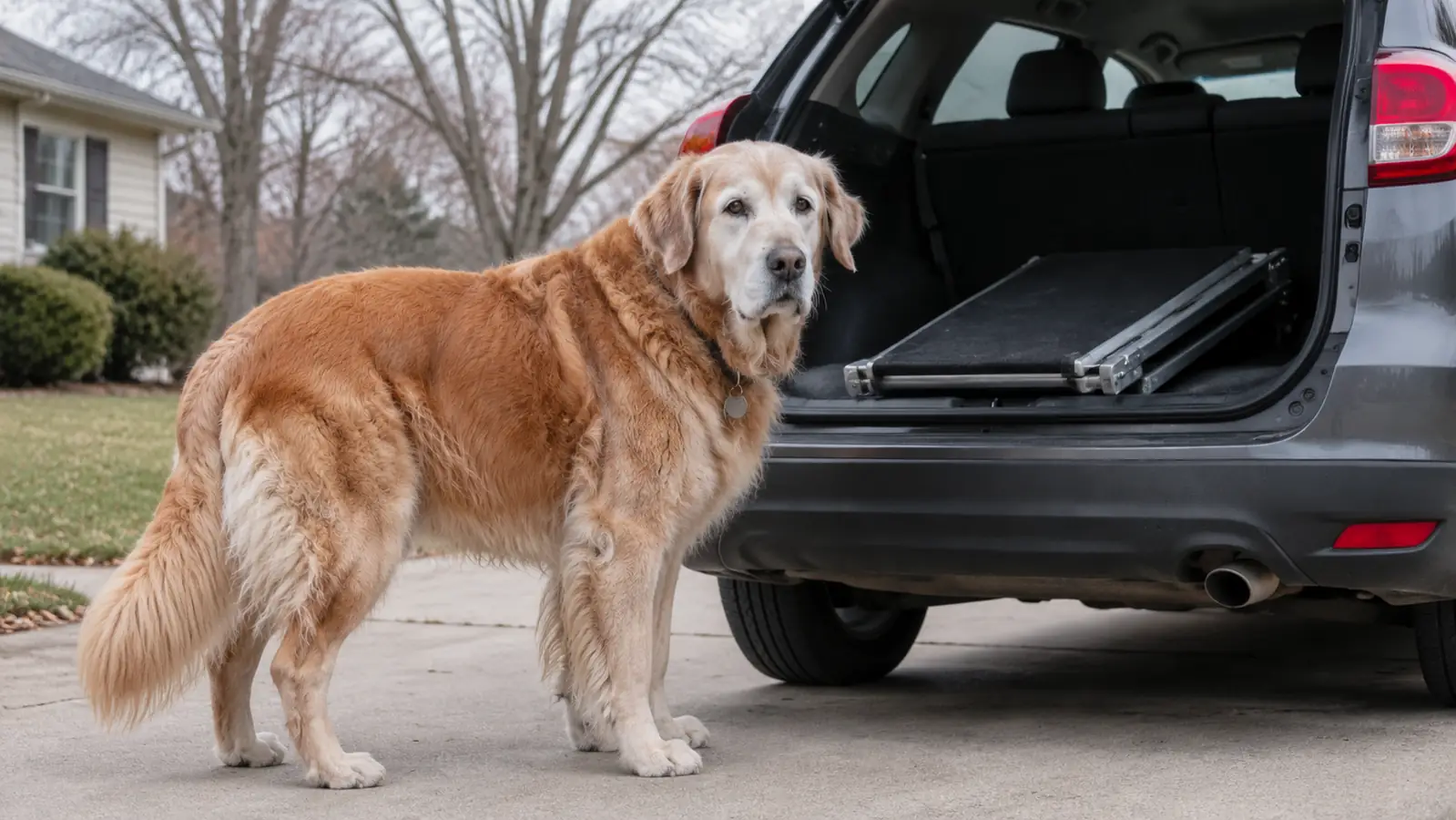
The morning Waylon stopped at the back of the CR-V and looked at me instead of jumping in, I knew something had changed for good. He is a yellow Lab, 68 pounds, eleven years old since March, and I cannot lift him. Neither can Gary, my husband, whose back has been bad for years. So the two of us stood in the driveway on a Tuesday in October 2025, looking at a tailgate that had never looked that high. I tried the things people suggest. I backed the car up to the bank at the edge of the yard. I put a bath towel under his belly and took some of the weight. Neither was a real answer for getting him in twice a week.
What we ended up with is a folding ramp, the PetSafe Happy Ride, and a routine that took about three weeks to build. I asked Dr. Reyes before I bought anything, mostly because I wanted to hear a vet say out loud that it was fine for him to walk up a ramp instead of being lifted. It was. Six months in, he uses it about twice a week, the Saturday trip to Frontier Park and the vet or an errand run. What follows is the order we did things in, including the part where it did not work and I nearly put the ramp in the garage for good.
The ramp that lives in the back of my CR-V
The PetSafe Happy Ride folding ramp is 62 inches long, 16 inches wide and 10 pounds per the listing, with side rails, a high-traction tread, rubber feet, a safety release latch and a 150 pound load capacity. It folds in half and rides in the cargo area. It took Waylon two weeks and most of a block of cheese to walk it on his own.
Amazon Check today's price on Amazon →Step 1: Unfold it flat on the ground before you ask anything of him
The ramp arrives folded in half, held shut by the safety release latch. The first thing I did wrong was unfold it at the car with Waylon standing right there. He took one look at this thing opening up beside him and went back to the porch. So I started over. I laid it flat on the driveway, both halves open, tread side up, and left it there for two days. He walked around it. He sniffed the rubber feet. On the third day I put a piece of cheese at the near end, let him take it, and let him walk away.
A folding ramp is a plastic frame with a walking surface, side rails and a rubber foot at each corner. That is all it is. It is not a moving sidewalk and it does not do anything on its own. The point of the flat-on-the-ground stage is that nothing about it is new or strange before you add height. Ten pounds of plastic sitting on a driveway is a lot less interesting to a dog than the same ten pounds leaning up against a car.
One honest note about that ten pounds. The listing says 10 pounds and that is accurate, but it is an awkward ten. Getting it out of the cargo area one-handed while a stiff dog leans on your leg is a chore, and I have pinched my fingers in the latch twice. If you have hand or shoulder trouble, plan to set it down and reposition your grip instead of swinging it.
Step 2: Build the walk on the flat before the car is involved
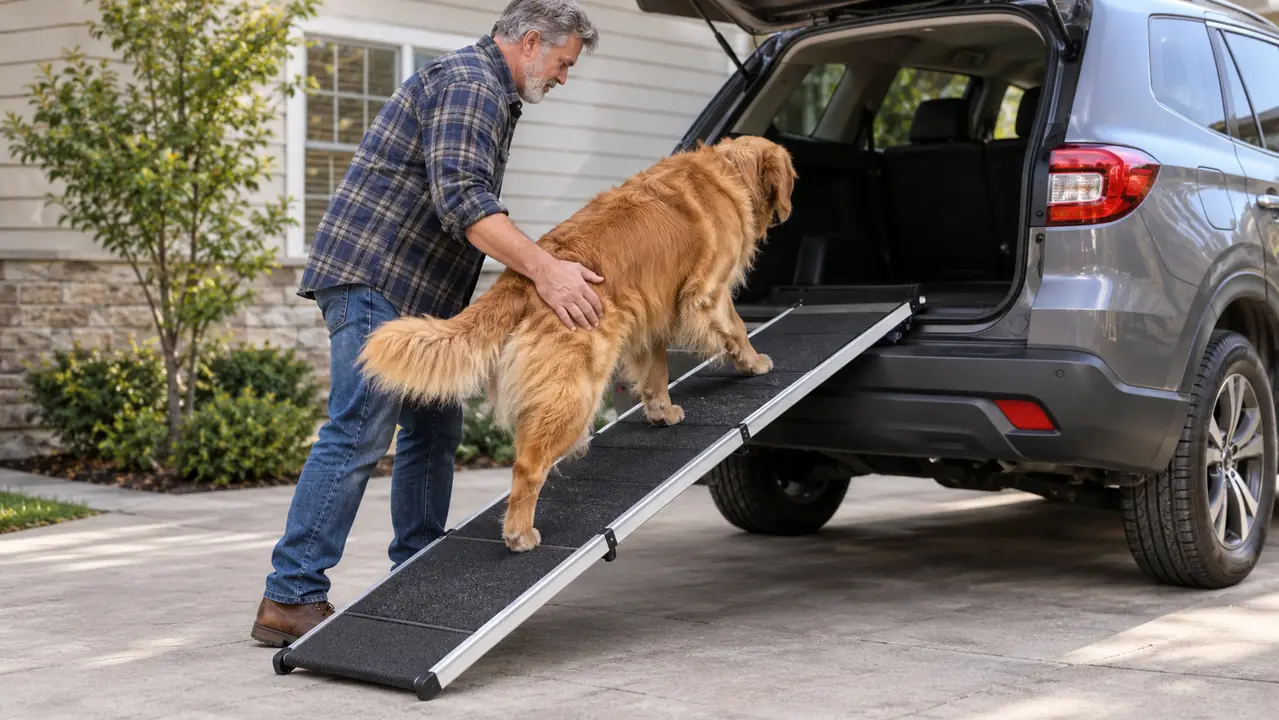
For two weeks we did five minutes in the morning on the driveway. He walked the full 62 inches from one end to the other, got a piece of cheese, turned around and walked back for another. That was the whole session. If he stopped halfway, I let him stand there and think about it. I did not push and I did not pick up his back end. The one time I tried to hurry him along with a hand under his belly, he stepped off the side and we started over the next day.
The side rails earn their keep here. They are low, just enough of a raised edge on each side to give a dog something to feel when he drifts. Waylon drifts left when he is unsure. Having a rail there meant a small correction instead of a foot on the ground and a restart.
I know two weeks sounds excessive for a piece of plastic. It is not, if the dog is old and stiff and has already decided the car is a bad idea. The two weeks were not about teaching a command. They were about him deciding the ramp was a floor and not a trap. A younger, willing dog may be done in a day. A dog like mine needs the two weeks, and you should be pleasantly surprised if it takes less.
Step 3: Set it on the hatch and set it the same way every time
The first time I leaned the PetSafe ramp against the open hatch of the CR-V, Waylon walked up about two feet and came back down. That was fine. That was the session. Over the next week he went further. The part I had to learn was the setup. The rubber feet go on level pavement, not on gravel and not on the grass at the edge of the driveway. The bi-fold has to be fully open with the safety release latch engaged, and I check that with my hand every single time, because a ramp that folds under a dog is worse than no ramp at all.
Park where the ground behind the hatch is flat and where you have room to stand beside him. I back into the driveway now instead of pulling in nose first, because it puts the hatch on the level. The angle at the CR-V's hatch height still feels steep to me. It is the one thing about this ramp I would change if I could. Sixty-two inches helps, and I have learned to stop looking at it from the side and just watch his feet.
A word about your own vehicle. A low sedan is going to give you a much gentler angle than my CR-V. If your car or truck sits higher than mine, walk the angle yourself before you ask the dog to. A ramp that is fine for a station wagon is not automatically fine for a lifted truck.
Step 4: Steady him, do not lift him, and keep the cheese at the top
On a good day Waylon walks up on his own and I stand at his left hip with a hand near his side, not on it, ready if he wobbles. On a bad day I have the LOOBANI sling on him, the soft band under his belly, and I take a little of his back end while he does the walking. That is the whole trick. He goes up under his own power. At 68 pounds nobody in this house is lifting him into a car, and I would rather he kept the muscle than had a free ride.
Gary's job is the far end. He stands at the open hatch with a piece of cheese and does not say anything, because two people talking at a dog at the top of a ramp is one person too many. Waylon goes to the cheese, gets it, and stands in the cargo area while I bring the ramp up and fold it flat behind him. That part matters. The ramp does not stay on the hatch once he is loaded. It folds and goes in beside him.
If your dog refuses at the bottom, that is information, not disobedience. It usually means the angle changed, a foot moved, or the ground is not level. Get off the ramp, reset the whole thing, and try once more. If he refuses twice, we quit for the day and try tomorrow. Pushing an old dog up a ramp is how you end up with a dog who will not go near the car at all.
Step 5: Fold it, stow it, and keep the tread clean
The safety release latch is what holds the two halves together when it is folded. I fold it, latch it, and it goes in the cargo area on top of the blanket. It has ridden there since May. Because it lives in the car, it is always with us, and that is the only reason the routine has stuck. A ramp that stays in the garage is a ramp you will talk yourself out of using on a cold morning.
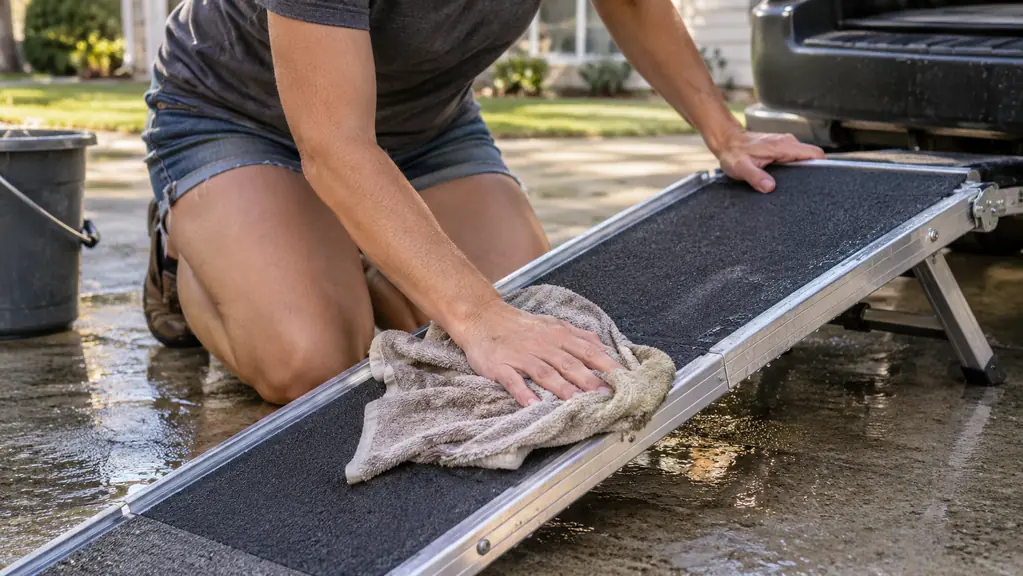
The high-traction tread picks up driveway grit and, in wet weather, leaves. I wipe it down with an old towel about once a month and knock the grit out of the rubber feet. What I will not do is use it on ice, or use it wet without wiping the tread first. High traction on a dry day is one thing. A wet plastic surface is another, and I am not going to find out how much another with an eleven-year-old dog.
What Else Helps
The ramp is one piece of a routine, and it is not the piece that changes how he feels. It changes how he gets in the car. The rest of it: I called Dr. Reyes before I bought the ramp and I have called her since, and I would tell anyone with an older dog to do the same before changing anything about how the dog gets around. She is the one who knows your dog's hips and your dog's heart. Neither a listing nor an article can tell you what is safe for him.
The sling handles the three wooden steps at the back door every morning and every evening, and the socks are for the kitchen and hallway floor, indoors only. The bed is for sleeping, and it is where he spends most of his day. None of these things fixed him. He is still an old dog and he is slower than he was a year ago. What I have is a set of tools that let him keep doing the Saturday walk at Frontier Park, which he loves, and a car ride that does not end with both of us upset.
The other thing that helps is time. I leave ten minutes earlier than I used to. Everything about an old dog takes longer, and the ramp is no exception. Rushing him at the bottom of it undoes a week of practice. If you take one thing from all of this, take the ten minutes.
The ramp does not make him younger. It gets him to the park on Saturday without either of us pretending he can still hop in.
Six months in, it is still the ramp in the back of the car
If you have a stiff dog, a level place to park, and nobody in the house who can lift 68 pounds, this is the setup that worked for us. The PetSafe Happy Ride ramp folds to 62 inches by 16 inches, carries a 150 pound load capacity per the listing, and has a tread I can wipe down with a towel. Buy the cheese too.
Amazon See the PetSafe Happy Ride ramp on Amazon →